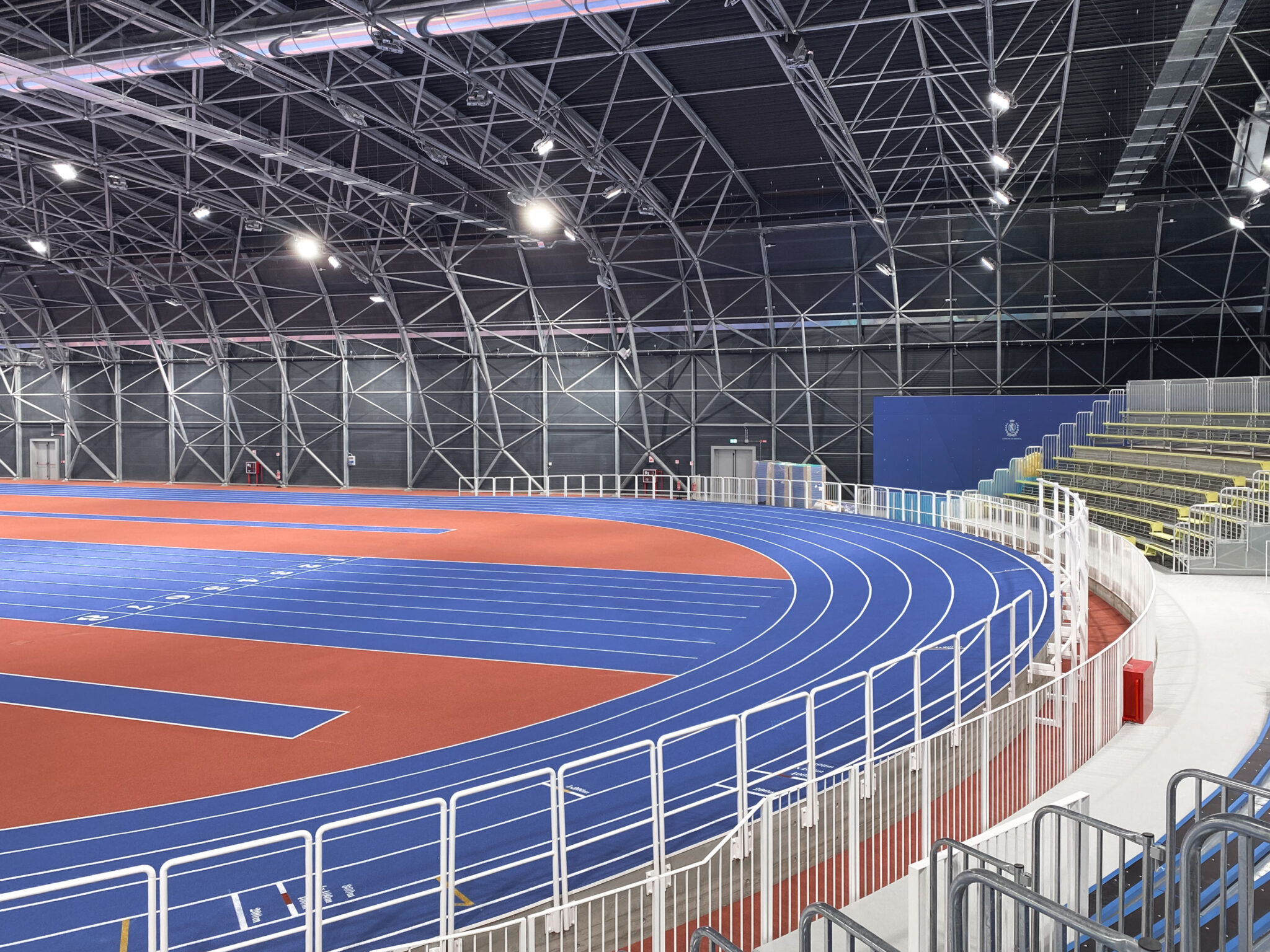
More space for sport at Tartaglia-Olivieri
New Gymnasium at the “Tartaglia Olivieri” Upper Secondary School, Brescia
The urban redevelopment project for the current car park area of the “Tartaglia Olivieri” Upper Secondary School involved collaboration and financial participation from both the Province and the Municipality of Brescia. The new gymnasium will be used primarily by students of the Institute, under the responsibility of the Province, but will also be made available to the Municipality for the organisation of activities of public interest outside school hours, with the aim of promoting not only educational development but also enriching the social life of the community.
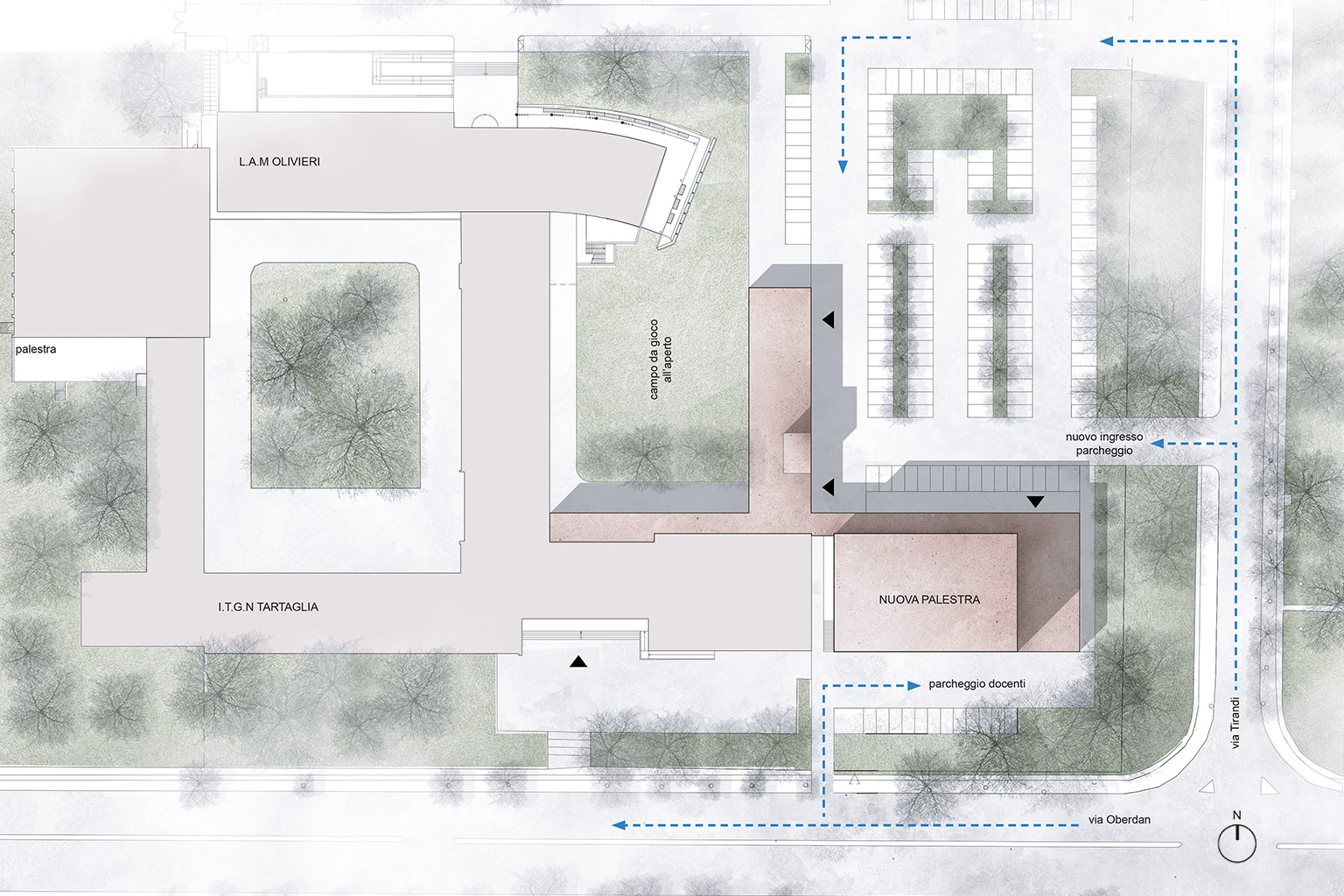
Following the preparation of the detailed-executive project by DVA, won through a public procedure, the technical and economic feasibility project (PFTE) was redefined, which led to the placement of the new gym in continuity with the existing frontage of the Institute on Via Oberdan, one of the main thoroughfares of the city, occupying a portion of the current public parking area.
Thanks to a multidisciplinary approach, already tested on other projects in the educational sector, and a productive dialogue with the two institutions to define the requirements framework, a series of shared design criteria were established:
- The need to create a facility capable of addressing the current undersizing of the sports amenities at the Tartaglia-Olivieri Institute;
- The relationship of the new building with the surrounding school and public spaces;
- The preservation of existing green areas to mitigate the impact of the building;
- The accessibility of all spaces, including for individuals with reduced mobility or sensory capacity;
- Microclimatic comfort in all areas;
- The use of materials and construction technologies that adhere to principles of aesthetic
and compositional quality, performance, and environmental sustainability; - The achievement of the NZEB (Nearly Zero Energy Building) classification, as required to
obtain the funding from the National Recovery and Resilience Plan (NRRP).
In addition to the construction of the gymnasium, DVA’s project also envisaged interventions aimed at the redevelopment of the entire area, including surface parking and the provision of new sports facilities such as a second block of changing rooms and an outdoor playing field within the current green space. However, these interventions will be addressed in future initiatives.
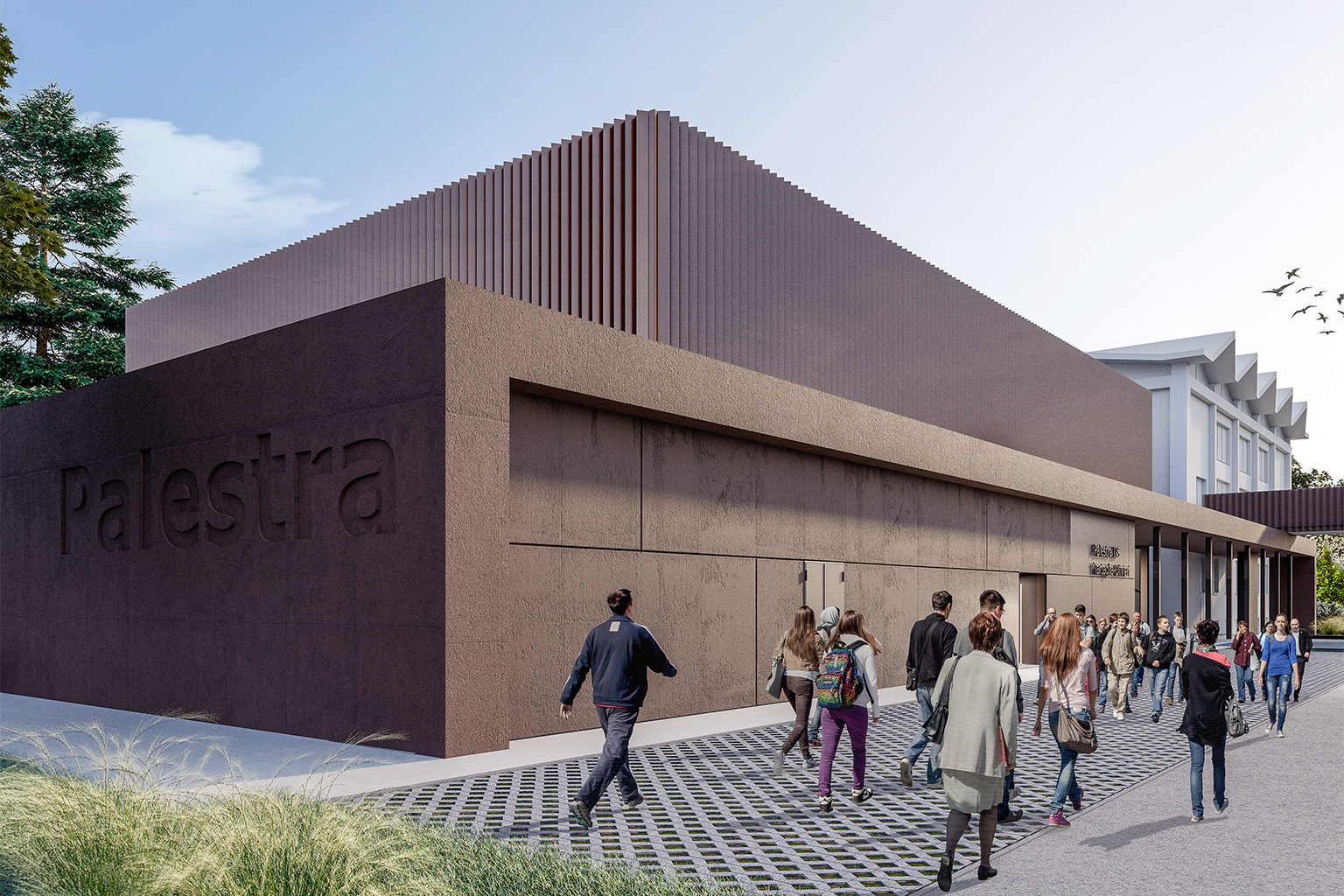
The gymnasium has been conceived as a linear monolith, continuing the existing frontage of the Institute and creating a new corner at the junction of Via Oberdan and Via Tirandi, where the main entrance will be located.
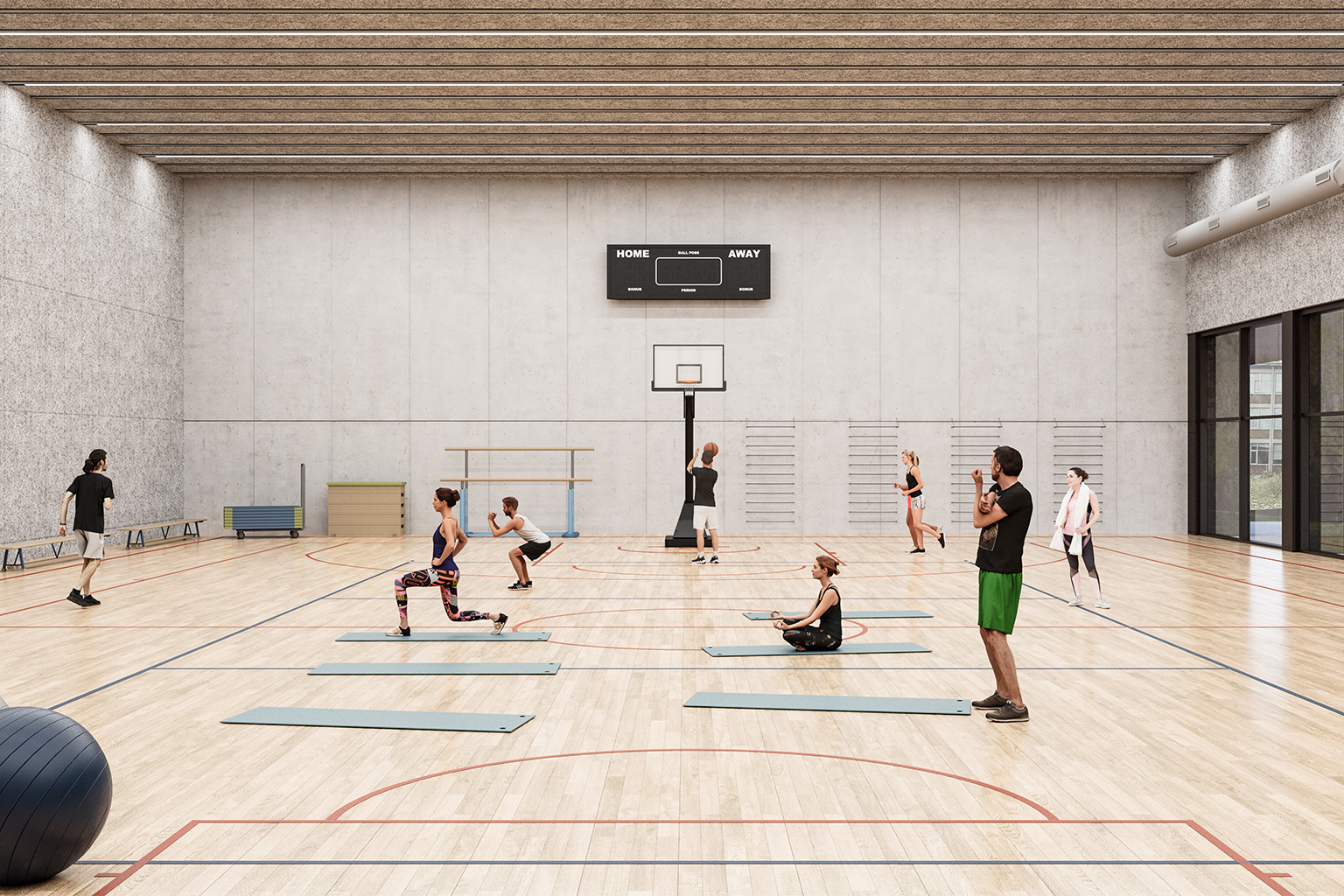
The composition of the building stems from the merging of two blocks: a low block where the services and changing rooms will be located, and a tall block, a large double-height void that will house the basketball and volleyball courts in compliance with CONI standards. The two adjoining blocks will be accessible from the north front via a glazed atrium that serves as a foyer.
As the new building is positioned on the existing public car park owned by the municipality, it was also necessary to construct a basement level garage to compensate for the lost parking spaces.
The material treatment of the external envelope highlights the building’s different internal functions: the lower section appears as a single dark brown exposed concrete shell, pigmented on site and topped with a green roof, while the upper section takes the form of a grey metal sheet frame that conceals the skylights and photovoltaic system on the roof.
The building, therefore, while clearly expressing its contemporary character, seeks to integrate harmoniously into its context, both in terms of layout and volume as well as composition and aesthetics, in accordance with current regulations.
To ensure the gym is autonomous and independent from the rest of the network, the building will be equipped with high energy-efficiency systems and will utilise renewable energy generated by photovoltaic panels.
In addition to energy-related aspects, every design decision aimed to identify the most environmentally responsible solution, in compliance with the Minimum Environmental Criteria required by current regulations.
The entire design process was supported by the use of the BIM methodology (Building Information Modelling), which enabled integrated and coordinated management of architectural, structural and systems design choices, in order to provide the contractor awarded the contract with all the necessary documentation to proceed with the works, which are scheduled for completion by the end of 2025.
4.000
GFA
[m²]
4
FINANCIAL FRAMEWORK
[M €]
730
BASKETBALL COURT SIZE
[m²]
2.600
STUDENTS WHO WILL USE THE FACILITY
“The new gymnasium for the Tartaglia-Olivieri school in Brescia is a facility for sporting activities open to the city, integrating into the urban fabric as an area for the strategic redefinition of access routes to the school complex. The gymnasium takes shape by aligning with the volumes of the existing school, defining the new pedestrian entrance. The base of the gymnasium is expressed as a large portal with a strong sculptural presence, characterised by dark brown concrete that reflects the colours of the neighbouring buildings. The new gymnasium therefore adopts a contemporary architectural language, sensitively responding to its context and contributing to the redefinition not only of a specific function, but also of an urban system on a human and neighbourhood scale.”
“The project for the new Tartaglia gymnasium followed an atypical procedural path compared to a standard building permit, including a programme agreement between the authorities (Province of Brescia and the Municipal Administration), signed to reconcile their respective needs, and the planning permission granted by derogation due to the original zoning designation of the area. All of this took place in a dichotomous scenario, caught between design requirements and the tight deadlines imposed by the NRRP (and the summer period) — a demanding challenge that ultimately made the team stronger and more united.”
Other projects

Construction Design in BIM, Project Coordination and On-site Assistance
Collegiate Student Housing, Milan


More space for sport at Tartaglia-Olivieri
New Gymnasium at the “Tartaglia Olivieri” Upper Secondary School, Brescia


In Harmony with the Landscape: The Foliage Road
Val Vigezzo state road, Re/Ribellasca Section (VCO)