From Greenwashing to the Digital Product Passport
DVArea · 24 September 2026
What changes from 27 September 2026 across the sustainability value chain, and why compliance must be designed from the outset. Sustainability is not something you simply communicate: it must be demonstrated through data and product labelling.
From 27 September 2026, companies addressing end consumers in the European market will no longer be able to make generic claims such as “we are sustainable” unless they can substantiate them with verifiable data and evidence.
From that date, Directive (EU) 2024/825, known as the Empowering Consumers for the Green Transition (EmpCo) Directive, will become applicable to commercial practices aimed at consumers. The Directive amends the EU rules on unfair commercial practices (Directive 2005/29/EC) and consumer rights (Directive 2011/83/EU), strengthening the obligation for B2C companies to support any environmental or social claim made to end consumers — on packaging, labels, websites or advertising — with documentary evidence. Companies operating in the B2B market are not formally the direct addressees of the Directive, but they will still feel its indirect effects when their customers apply the same standards further downstream.
It is useful to clarify one point that is often confused: the Green Claims Directive, often incorrectly referred to as the Greenwashing Act, which would have introduced prior verification of claims by an independent third party, was put on hold by the European Commission in June 2025 and remains suspended, with no confirmed date for work to resume. The concrete obligation taking effect from 27 September 2026 is the one introduced by the EmpCo Directive.
The crackdown on greenwashing is not simply a consumer-protection measure, but the beginning of a deeper transformation. It is a process that starts with greater transparency in communication and progressively extends to product design itself, through standards that will become increasingly stringent across the European market: from Type III environmental declarations such as the Environmental Product Declaration (EPD) to the Digital Product Passport (DPP), whose introduction will be progressive and differentiated by sector.
Communication, design and certification can no longer be treated as separate chapters: they form part of the same value chain. Companies that are able to manage this process in an integrated way gain a real competitive advantage, rather than reacting only downstream, once reputational damage has already occurred.
What is greenwashing?
The term “greenwashing” is, in a sense, already narrower than the legislation designed to address it. This was clearly highlighted by the opening panel of the event “Green Claims: from compliance to strategy”, organised by Deloitte Legal in Milan on 16 September 2026. The EmpCo Directive does not protect only the environment in the strict sense, but addresses the broader sustainability framework, including environmental, social and governance dimensions. Referring only to “green” claims is therefore reductive: it would be more accurate to speak of ESG claims, because even a generic statement about respect for workers or an ethical supply chain falls within the same sphere of responsibility.
A green claim is any non-mandatory statement concerning a product, process, company or future commitment that communicates an environmental or social performance or impact through any channel: a website, social media, press release, packaging or label. A claim remains legitimate as long as it is supported by truthful data. It becomes greenwashing when the statement is not backed by evidence, when the performance being communicated is not linked to concrete growth targets within the company’s business plan — sustainability reporting must now include a verifiable pathway towards 2030 and 2050 — or when brands and logos suggest the existence of a certification that does not actually exist.
The blacklist and the greylist: what can no longer be said
Strengthening the burden of proof
The principle that a company must be able to substantiate its claims with adequate evidence is not, in itself, new under EmpCo: it is already established under the general framework governing unfair commercial practices (Directive 2005/29/EC, transposed in Italy through the Consumer Code), which has long required consumer-facing claims to be supported by documentary evidence. The most relevant point, highlighted in the contribution by lawyer Emilio Cucchiera, concerns rather the moment at which such evidence must be available: with the full application of EmpCo, the burden shifts in practical terms onto the company already at the preliminary stage of a proceeding, not only during the substantive assessment. During the pre-investigation phase, a company may in fact have only a few days to provide documentation supporting the challenged claim: if the dossier containing analyses, certifications and third-party verification is already complete, the matter may be closed quickly; if the evidence is not immediately available, a formal investigation is more likely to be opened and may ultimately result in a finding of infringement.
The resulting sanctions operate on four distinct levels, which are not mutually exclusive:
- Administrative fines: according to early estimates relating to the Italian implementing legislation, fines may reach up to €10 million for the most serious infringements or 4% of annual global turnover.
- Civil liability: unfair competition actions may also be brought by other companies operating in the same sector.
- Criminal liability: in the most serious cases, and where intent is established, conduct may potentially fall within fraud or commercial fraud offences, with possible implications, again in the most serious cases, for corporate administrative liability under Legislative Decree 231/2001. These aspects must be assessed on a case-by-case basis with legal counsel and do not arise automatically.
- Reputational damage: often the most difficult consequence to reverse, because it affects public perception regardless of the legal outcome of the proceeding.
In Italy, Directive 2024/825 was transposed through Legislative Decree No. 30/2026, which amends the Consumer Code (Articles 21–22 and 27) on misleading commercial practices and gives the Italian Competition Authority (AGCM) the power to establish infringements and impose sanctions. This is complemented by the faster and more informal role of the Italian Advertising Standards Authority (IAP), which may take interim action against advertisements containing misleading environmental promises even before formal proceedings are initiated before the AGCM.
When litigation is already a reality: Italian greenwashing cases
The risk is not merely theoretical. The Panino Giusto case, involving the Italian restaurant chain and Benefit Corporation certified as a B Corp since 2020, was the subject of a collective injunction action brought by the consumer association Codici over the prominent use of slogans linked to its status as the first Italian restaurant company to obtain B Corp certification. These were considered generic statements that were not supported by evidence immediately verifiable by consumers.
Even more significant from a B2B perspective is the Alcantara v. Miko case. On 25 November 2021, the Court of Gorizia granted Alcantara’s urgent application on an interim basis, prohibiting Miko from using claims such as “100% recyclable” and “environmentally friendly” in relation to its Dinamica microfibre, in what was widely described as the first Italian court order concerning greenwashing between competitors. The case, however, had a second chapter: in March 2022, on appeal, the same Court of Gorizia upheld Miko’s arguments, found Alcantara’s unfair competition action unfounded and revoked the interim order. It nevertheless remains the first Italian judicial precedent on the issue, and the dispute itself — regardless of its final outcome — shows how much the interpretation of the matter is still evolving. The Deloitte panel drew a broader lesson from this: for an economic operator, litigation brought by a competitor is not only a risk to avoid, but can also represent a market opportunity if the company’s own communications are already robust and verifiable. This is one more reason to build a strong evidence dossier from the outset.
Most consumers choose a product partly on the basis of its stated sustainability credentials: if they feel misled, they may not simply switch supplier, but may also seek compensation.
There is, however, a side effect of the stricter regulatory framework that deserves attention, and it was clearly raised by Lucia Silva, Group Chief Sustainability Officer at Generali: “[…] those who have been genuinely working on sustainability for years now risk feeling undermined by a context in which everything is labelled ‘sustainable’ and then, suddenly, everything is called into question.” Fear of sanctions may lead some companies to stop communicating their genuine environmental achievements altogether, in order to avoid exposure to risk, even where the underlying data is sound and verifiable. This phenomenon has a specific name: greenhushing. It refers to the strategic silence adopted by a company to avoid scrutiny, even when it would have legitimate grounds to communicate real progress. The paradox is clear: regulation designed to increase transparency may, if applied in a more punitive than collaborative manner, produce the opposite effect — less communication rather than more. The more reassuring corrective indicated by the institutions themselves, in the first implementation FAQs issued in July/August 2026, is that authorities will also consider a company’s efforts and trajectory, rather than looking only at an isolated snapshot of a single claim.
From communication to governance: compliance must be designed upstream
The key message is that greenwashing is not merely a communication error: it is a symptom, while the underlying cause lies further upstream, at board level, before any communication takes place. If sustainability is not embedded in strategic decision-making, but remains merely a final section written by the marketing department, the resulting communication will always be exposed to risk, no matter how well it is written.
For this reason, the real operational response requires bringing together, around the same decision-making table, functions that have traditionally worked sequentially rather than in parallel: marketing, legal, sustainability, procurement, communications and the CFO. Regulatory timelines are tight, interpretative margins remain broad, the exact scope of some provisions is not yet fully defined, and the operational consequences of an error can be immediate. In this context, two elements become critical: a data-driven approach — decisions about what to communicate, and how to communicate it, must be based on measured impact data rather than on marketing intuition — and the planning of future targets, because a claim concerning a commitment such as emissions reduction or a 2050 target can only be defended if it is supported by a plan including audits and ongoing monitoring over time.
A solid methodological reference is ISO 14068-1:2023 on carbon neutrality, which provides a structured framework for measuring emissions, prioritising their reduction, using offsetting only for residual emissions and finally reporting the results for a company, product or organisation.
An ESG audit aligned with a monitored action plan is what distinguishes a company that can defend its position during an investigation from one that is exposed to sanctions.
Ecodesign and the value of Type III certifications
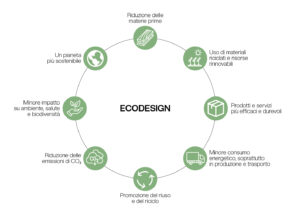
If communication compliance concerns what a company says, Ecodesign concerns what a company designs. Regulation (EU) 2024/1781, known as the Ecodesign for Sustainable Products Regulation (ESPR), in force since July 2024, extends sustainable design requirements to almost all product categories placed on the European market.
The ESPR does not simply call for a generic environmental commitment: it defines specific design criteria such as circularity, durability, recyclability, recycled content, adaptability, flexibility, disassemblability, component replaceability, and material mass balance, which become minimum requirements for access to the European market. But designing a product according to these criteria is not enough if this cannot be demonstrated. This is where certifications come into play, together with the distinction between three types of environmental labelling.
- Type I (ISO 14024): labels of environmental excellence based on thresholds and targets, such as the EU Ecolabel. They represent a challenge because they position the product within a high-performing category compared with competitors.
- Type II (ISO 14021): environmental self-declarations made by the manufacturer, without verification by an independent third party. With the EmpCo Directive, this type of claim is tending to lose commercial credibility: the market increasingly requires the process and methodology behind an environmental statement to be validated by an independent third party.
- Type III (ISO 14025 – EPD): quantified environmental declarations verified by an independent third party according to a codified scientific methodology. They provide a credible snapshot of the product and respond to the market’s growing demand for data transparency.
The message for product-based companies is clear: the third party does not certify the final result in the abstract, but rather the process and methodology through which that result was achieved and measured. This is the difference between a certification that can support a company during an investigation and a logo that, on its own, offers no real protection.
EPD: a scientific snapshot of the product, monitored over time
An EPD, or Environmental Product Declaration, is a third-party verified Type III environmental declaration. It quantifies the environmental impact of a product across its entire life cycle — including emissions, resource consumption, water use and waste — through a Life Cycle Assessment (LCA) carried out according to a codified ISO methodology and verified both by the programme operator managing the scheme and by an independent third party.
Why is it useful in practice? Because it provides product data in a scientific and comparable way, transforming a stated intention — “our product has a low impact” — into a verifiable figure that can be traced in a public register. It is the tool that allows a company to respond, with a document rather than a slogan, to the question that the market — and a supervisory authority in the event of an investigation — is now asking.
Towards the DPP: what is the Digital Product Passport?
The final link in the chain, and the one towards which the entire European regulatory framework is converging, is the Digital Product Passport (DPP). It is a digital identity card associated with a physical product, containing structured data on materials, origin, environmental impact, repairability and end-of-life options, accessible by scanning a QR code, an NFC chip or a digital watermark applied to the product.
The DPP is governed by the ESPR itself, which introduces the requirement progressively and on a differentiated basis by product category. There is no single deadline: instead, implementation will follow a timetable established through sector-specific delegated acts adopted by the European Commission. The first identified categories, including textiles, batteries and consumer electronics, are expected from 2027 onwards, with other sectors following according to their own timelines in subsequent years.
It is a digital infrastructure that makes the data collected upstream through EPDs and ecodesign processes verifiable and shareable throughout the entire value chain. For this reason, a company that has already structured its environmental data for an EPD will have an advantage when the DPP becomes mandatory for its sector: the data will not need to be recreated from scratch, but reorganised.
The objectives that the European Union assigns to the DPP are consistent with the entire pathway described in this article: to increase transparency across the value chain, strengthen supply-chain traceability, reduce the environmental impact of goods placed on the market, and provide concrete support for the transition towards circular economy models. In short, the aim is to significantly increase the traceability, transparency and verifiability of data, making it much more difficult to support an unsubstantiated claim anywhere along the value chain.

One integrated value chain, not separate compliance requirements
Communication, governance, product design and certification are, in the day-to-day operations of many companies, managed by different functions, with different timelines and different languages. The European regulatory framework outlined in this brief overview — from the EmpCo Directive to the ESPR, from EPDs to the future DPP — points in exactly the opposite direction: these elements are, and must be, part of the same value chain, managed in an integrated way, from the boardroom down to each individual claim published on a website.
It is precisely within this space — where data, design and communication converge — that ODUELab operates on a daily basis. ODUELab is DVArea’s technical and scientific department dedicated to environmental and social sustainability and wellbeing. We do not assess the legal compliance of claims, which remains the responsibility of legal counsel; instead, we build the technical and quantitative foundation that makes those claims sustainable in the literal sense of the term: through LCA studies, EPD preparation, product ecodesign processes, environmental impact assessment, and the organisation and traceability of data in preparation for EPD and DPP requirements.
This work provides the technical evidence needed to support compliance assessment. Alongside this, we bring expertise in digital modelling and digital twins, as well as an approach to sustainability that also encompasses wellbeing and the social dimensions of the environments we design.
Because documented sustainability — rather than sustainability that is merely declared — is now the only form that both the market and the regulatory framework recognise.
Erika Siverio
Engineer | LEED AP | Environmental Sustainability Dept. ODUElab
Bibliography and Web Sources
https://eur-lex.europa.eu/eli/dir/2024/825/oj/eng
https://environment.ec.europa.eu/topics/circular-economy-topics/green-claims_en
https://environment.ec.europa.eu/strategy/circular-economy_en
https://www.uni.com/direttiva-greenwashing-tra-tutela-dei-consumatori-e-promozione-della-sostenibilita/
https://www.deloitte.com/it/it/blog/green-claim-compliance-o-strategia.html
https://www.eticanews.it/green-claims-e-filiera-il-nuovo-position-paper-con-deloitte-legal/
https://www.lifegate.it/greenwashing-direttiva-empowering-consumers-for-the-green-transition
https://www.impresacity.it/news/56612/stop-al-greenwashing-in-arrivo-dal-27-settembre-le-nuove-regole-ue-con-sanzioni-fino-a-10-milioni-di-euro.html
https://europa.today.it/attualita/norma-contro-greenwashing-cosa-prevede.html
https://giornaledellepmi.it/greenwashing-al-via-le-nuove-regole-contro-le-aziende-furbette-dellecosostenibile/
https://www.unibocconi.it/it/news/i-guardiani-del-verde
https://www.unibocconi.it/it/news/greenwashing-lesperienza-che-cambia-lo-sguardo
https://www.environdec.com
https://www.environdec.com/home
https://www.iso.org/standard/72637.html
https://www.iso.org/standard/38498.html
https://www.iso.org/standard/37456.html
https://knowledge4policy.ec.europa.eu/european-platform-life-cycle-assessment-eplca_en
https://www.bureauveritas.it/needs/la-norma-iso-14068-12023-carbon-neutrality
https://www.environdec.com
https://www.environdec.com/home
https://www.iso.org/standard/72637.html
https://www.iso.org/standard/38498.html
https://www.iso.org/standard/37456.html
https://knowledge4policy.ec.europa.eu/european-platform-life-cycle-assessment-eplca_en
https://www.bureauveritas.it/needs/la-norma-iso-14068-12023-carbon-neutrality
https://eur-lex.europa.eu/legal-content/IT/TXT/?uri=CELEX:32024R1781
https://single-market-economy.ec.europa.eu/news/new-digital-product-passport-dpp-web-page-launched-2026-07-17_en
https://www.eticanews.it/green-claims-e-filiera-il-nuovo-position-paper-con-deloitte-legal/
https://valori.it/wp-content/uploads/2022/01/greenwashing-Alcantara-vs-Miko-ordinanza-del-25-novembre-2021-del-Tribunale-di-Gorizia-R.G.-2021-712.pdf
https://www.ilcaso.it/giurisprudenza/archivio/34285.pdf
Deloitte Event
Green Claims: From Compliance to Strategy — Risks, Actions and Opportunities in the New EU Landscape, Deloitte Legal, Milan, 16 September 2026

Looking for more engaging content?
Subscribe to the DVArea Newsletter to stay informed about our latest updates in architecture, construction, digitalisation, and integrated sustainability.