
Experience in supporting the team: the importance of the technologist
DVArea · 27 August 2026
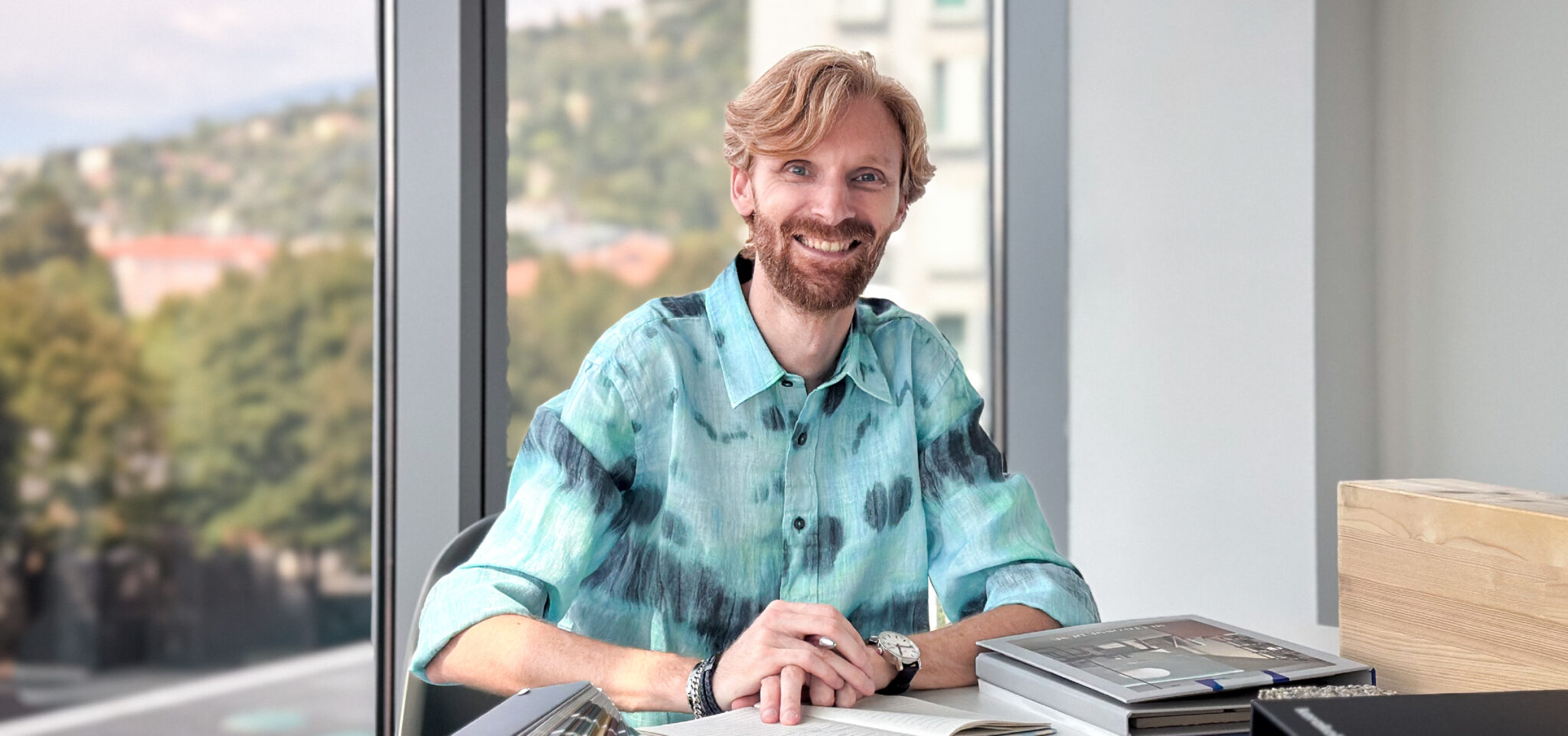
After introducing our BIM and acoustic consulting departments, we now turn to another equally important role within a multidisciplinary design group: that of the technologist. A specialist in construction technologies, the technologist acts as a bridge between the design concept and its practical feasibility. In this interview with Denny Pè, Associate at DVArea and Head of the Technology Department, we retrace his professional journey and explore the distinctive aspects of his role: knowledge of materials and construction technologies, support for project teams, and the development of tailor-made solutions for each project.
Tell us about yourself and what your day-to-day work involves as Head of the Technology Department.
I was born in Lumezzane, but I have the perfect Brescia mix of the “three Vs” running through my veins: Valcamonica, Valtrompia and Valsabbia. Over the years, however, people have tried to attribute all sorts of origins to me: Scottish, Irish, Dutch, Danish, Swedish and even Siberian.
In my role as Head of the Technology Department, my daily activities are many and varied. I liaise with suppliers and manufacturers, attend meetings and industry trade fairs to keep constantly up to date with the latest developments in the construction sector, and share technical expertise and knowledge across DVArea to provide the best possible support to project teams. I am also responsible for organising internal technical training sessions, promoting professional development and the dissemination of know-how throughout DVArea.
You are one of the company’s longest-standing team members and have personally witnessed DVArea’s evolution and growth. What are the most significant changes you have seen over the years? Is there a particular anecdote or episode connected with this journey that has stayed with you and that you would like to share?
I was part of the original group of 16 people, including the six founding partners, who embarked on the DVA journey. Today, DVArea has 170 team members. At the beginning, it was certainly much easier to remember everyone’s name.
From the very start, however, I felt that the partners had complete confidence in me. They saw potential in me that I had not yet recognised in myself. In 2014, I returned to Italy after spending a couple of years abroad. A few months later, I met architects Andrea Solazzi and Armando Casella, two of the future founders of DVArea. After an initial internship, I began working alongside Andrea on a project. There were meetings and discussions with designers from different disciplines, structural engineers, MEP consultants and façade specialists. It was a completely new world for me, as my previous experience had mainly been in interior design.
After three or four months, Andrea said to me: “I’m getting married next week, and then I’ll be leaving for my honeymoon. You’ve seen how everything works, and I’m confident that you can take over from me for the next month. Everything will be fine!”
The way he put it made it sound almost straightforward. The only problem was that the project in question was the construction site for Pier C, part of the expansion of Rome Fiumicino Airport. It was an extremely demanding stress test, but also an invaluable and stimulating learning experience that helped me grow very quickly.
The outcome? I survived and, fortunately, the project did not go badly either!!!

How did your specialisation in construction technology develop? Was it a natural choice that evolved over time, or was it prompted by external circumstances, perhaps in response to a specific company need?
I believe it is an innate inclination, typical of someone from Lumezzane. I grew up in a highly industrialised area, where companies and small-scale craftsmen, like my father, have always focused on product quality, material selection, supply-chain control and attention to detail. Here, the product is understood both as a finished element and as a component within a larger, more complex system.
I later encountered the same way of thinking during my university studies, when I discovered the work of the great master Mies van der Rohe and his famous statement, “God is in the details”. It was one of those moments when you realise that something you have always understood instinctively has finally been given a clear definition. I came to understand that the beauty of a project does not arise solely from aesthetics and composition, but also from precision; that nothing is accidental and that every detail has a reason for being. In that idea, I recognised the way of observing the world that I had grown up with, and I discovered an approach to architecture that I felt was profoundly my own.
Your role requires the ability to understand the implications that each technological element may have on a project, combining technical expertise with knowledge of regulations. How do you develop this kind of cross-disciplinary perspective?
Knowledge of regulations is based approximately 80% on study and practical application and 20% on experience. You encounter the same issue several times and, on each occasion, explore a different aspect of it. You add another piece to the puzzle, connect different concepts and gradually build an increasingly complete overall picture.
A cross-disciplinary understanding of a project, on the other hand, is a skill that must be continually developed over time. I initially cultivated it through BIM coordination, when I was responsible for coordinating multidisciplinary design activities at DVA. The path towards transforming the practice first into an integrated design company and later into what DVArea is today had already been clearly mapped out from the earliest years.
This multidisciplinary perspective was subsequently broadened by my interest in 4D, the time dimension applied to BIM models, and through my studies in project management. These experiences taught me to view a project not simply as the sum of separate disciplines, but as an interconnected system in which every technical decision affects all the others.
You have a broad understanding of the building as a whole, which enables you to synthesise complex information and identify critical issues before they become problems. Where does this ability come from, and how do you apply it in practice within projects?
It all stems from the fact that, deep down, I consider myself “a lazy person”. Frank Gilbreth, an American engineer, once said: “I will always choose a lazy person to do a difficult job, because a lazy person will find an easy way to do it.”
Of course, this is intended as a provocation. To me, it means working intelligently and investing time in analysing a critical issue and resolving it in the simplest possible way.
When a critical issue has already become a problem, you almost always end up working under pressure, with tight deadlines and high levels of stress. Under those conditions, it is easy to lose clarity, and identifying the best solution becomes more difficult. For this reason, I try to anticipate potential issues, understand the interactions between the different disciplines, and resolve them while they are still relatively simple to manage.
Your work requires a high degree of autonomy, yet at the same time you are a point of reference for all the teams. How do you manage the balance between individual work and providing cross-functional support to colleagues working across the company’s different areas?
It is not always easy and, precisely for this reason, it demands a great deal of flexibility. It is a difficult job to plan: every day starts with a schedule, but it rarely ends with that schedule having been followed from start to finish.
Alongside planned activities, such as meetings with suppliers, internal technical training, and managing the technical library and materials archive, I also oversee projects and consultancy assignments directly. In addition, there are constant discussions with the different companies and specialist teams across the DVArea network: the structural engineers at DVS, the building services engineers at DVMEP, the professionals at ODUElab, the acoustic specialists at Dieci Decibel and, of course, the design teams.
These interactions often completely reshuffle the day’s priorities: a consultation needed for an imminent deadline, an unexpected request for input ahead of a client meeting, or an issue that must be resolved quickly. It is part of the role and, ultimately, one of the aspects I appreciate most. Every day is different, and every discussion is an opportunity to share expertise and find the best possible solution.
In practical, day-to-day terms, what does it mean to be the person teams turn to when technological questions or critical issues arise?
On a daily basis, more often than not, my role is that of “moral support”. The teams have often already identified a solution or strategy; they simply need someone to discuss it with, to validate their approach or to explore certain technical aspects in greater depth before moving forward with greater confidence.
The most interesting aspect is that every project presents a unique challenge, with its own specific features and critical issues. There are never any truly standard solutions and, precisely for this reason, every discussion becomes an opportunity to explore a topic in more detail, evaluate new materials or investigate a different technology.
In this sense, the support is mutual. I try to make the experience I have gained over the years available to others, but every project also gives me something new in return.
In a rapidly evolving sector, how important is continuous professional development, and how do you put it into practice in your work?
It is essential, although I believe that today the real challenge lies less in finding information than in knowing how to select it. We are constantly exposed to new products, materials, technologies and digital tools, and, above all, to an ever-evolving regulatory framework. One only needs to consider European sustainability directives, increasingly stringent Minimum Environmental Criteria, or the ongoing integration of the Vertical Technical Rules within fire-safety regulations. These changes have a tangible impact on the way projects are designed and require continuous professional development.
For this reason, I try to maintain an ongoing dialogue with manufacturers, suppliers and industry professionals, while also attending trade fairs, conferences and technical meetings. However, the most effective form of learning comes from immediately putting newly acquired knowledge to the test and verifying its applicability in real projects.
Another aspect I care deeply about is sharing. Knowledge only has value when it is shared. This is why I organise internal training sessions and try to pass on what I learn to the teams, creating a shared body of expertise. Ultimately, the aim is to ensure that the whole of DVArea can approach the challenges of future projects with greater awareness and confidence.

Looking for more engaging content?
Subscribe to the DVArea Newsletter to stay informed about our latest updates in architecture, construction, digitalisation, and integrated sustainability.


